
IRANZ news briefs
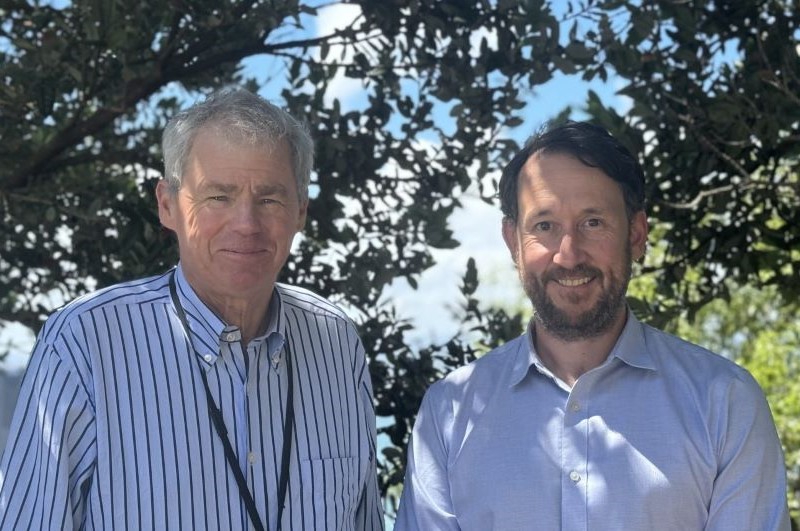
Professor Graham Le Gros and Dr Nicholas van Panhuys. Since completing his PhD at the Malaghan Institute in 2007, Dr Nicholas van Panhuys has built an international career researching how allergies develop. He returned to the institute to share his latest findings. Photo: Malaghan Research Institute.
Motu: Winners at the 34th Australia New Zealand Econometric Study Group Meeting
In February, Motu Research hosted the 34th Australia New Zealand Econometric Study Group meeting (ANZESG) in Wellington.
Awards are given based on research presented at the meeting, and the quality of the presentation, including discussion - emphasis is placed on encouraging and supporting the achievements of emerging researchers who are either PhD students, or recent graduates.
Syed Zulqernain Hussain, from the University of Otago
Paper: Does the pass-through of the central bank's policy rate to retail rates of commercial banks vary with phases of the business cycle? A case of an emerging financial market
Julia Ferreira, from Merkle
Paper: Transmuting Unequally Spaced Data: A MIDAS Regression Touch to Forecast Real GDP Growth in Brazil
Wei-Lin Chen, from the Auckland University of Technology
Paper: The Impact of Partisan Politics on Personnel Composition: Evidence from North Carolina's Sheriff's Offices
ERL completes dermal irritation study for promising skin treatment
Estendart Research (ERL) recently completed a dermal irritation study in rats, investigating a topical non-antimicrobial product designed to treat superficial skin pyodermas. The study marks an important step in evaluating the product's safety before it can progress to human clinical trials.
Preclinical research like this is essential in the early development of new drugs and medical devices, particularly in areas where artificial intelligence cannot yet replace laboratory testing. These studies provide vital data on how a treatment interacts with the body (pharmacodynamics) and how the body processes it (pharmacokinetics).
At ERL, preclinical studies are a core part of their work, supporting clients in identifying safe starting doses and assessing the potential toxicity of new treatments. By ensuring products meet strict safety standards, these studies help lay the foundation for effective and ethical human trials.
This latest research contributes to the development of innovative, non-antibiotic options for managing common skin conditions, potentially reducing reliance on antimicrobial treatments and helping to combat antibiotic resistance.
Malaghan's Kjesten Wiig: Bringing life-changing treatments to life
With decades of experience bridging gaps between the lab and clinic, academia, start-up biotech and government, Professor Kjesten Wiig is heralding a new era of research and discovery at the Malaghan Institute.
The life of a scientist revolves around experiments. Societal norms such as the 9 to 5 working week fall away to accommodate the demands of cells, substances and equipment that need tending with meticulous precision and unrelenting dedication. One experiment must be repeated many, many times to ensure the reliability of results.
Once the lab work is finished, something that can take months or even years for each project, researchers try to make sense of the swathes of data they have collected. It's like assembling a puzzle without a reference image, what bigger picture emerges when all the pieces of data come together?
“Few things bring joy and satisfaction to a scientist more than when experiments they have been toiling on for months, if not years, come together to give satisfying results that reveal something new about the world,” says Kjesten.
Kevin Jenkins appointed to BRANZ Board
BRANZ Chair Nigel Smith recently announced the appointment of Kevin Jenkins to the BRANZ Group Board of Directors.
“As a founding member of business advisory firm MartinJenkins, Kevin has more than 30 years' experience of helping organisations across a wide range of industries to drive performance and tackle complex challenges.
“He joins BRANZ at a critical time. Earlier this year, we launched a new long-term strategy focusing on four main priorities: affordability, quality, resilience, and sustainability. Addressing skyrocketing building costs; combating inappropriate building practices; meeting carbon reduction targets and adapting to climate change are among the most pressing issues we face.”
Bragato: Invitation for research proposals
Bragato Research Institute is inviting Expressions of Interest (EOIs) to undertake new research projects with wide benefits for the New Zealand wine industry. The funding for these new projects will be provided by BRI through the New Zealand Winegrowers levy.
BRI has recently refreshed its Research Strategy - identifying seven research Priority Outcomes, and mapping current research against those outcomes to reveal gaps which will be prioritised through the EOI process.
Cawthron: New Westpac report highlights huge potential of Aotearoa New Zealand's blue economy
In this opinion article by Dr Cath McLeod, Cawthron's Chief Science Officer, she reviews a report by Westpac. She writes that the recently published report highlights the potential of New Zealand's ocean estate to underpin the growth of a new, sustainable blue economy. "The report reveals that marine activity currently contributes at least $10bn in value add to the New Zealand economy, and predicts that by 2035, sector value add will rise to $14bn pa, with even higher growth possible if we are able to find sustainable ways of utilising marine mineral resources.
"I was pleased to see the report reiterate the necessity for a swing towards a blue economy, which in my view offers huge opportunity to fully integrate impeccable environmental credentials, social values, and high-tech marine innovation into the development of commercial products and services."
Malaghan visiting researcher: Dr Ian Myles
Dr Ian Myles, a leading allergy researcher from the US National Institutes of Health, visited the Malaghan Institute to share his latest insights into what drives the development of allergies in children. He also spoke with Susie Ferguson on RNZ, shedding light on how everyday pollutants might be fuelling the rise in allergies around the world.
Allergies are becoming more common, but why? Dr Myles' research suggests that modern living, particularly our exposure to pollutants and chemicals in everyday products, could be altering the natural balance of microbes on our skin, making us more vulnerable to allergic diseases like eczema. His work explores how the skin microbiome acts as a defence system and how cultivating the right microbial diversity early in life could help prevent allergies before they start.
Malaghan visiting researcher: Dr Nicholas van Panhuys
Since completing his PhD at the Malaghan Institute in 2007, Dr Nicholas van Panhuys has built an international career researching how allergies develop. He returned to the institute to share his latest findings.
As an Associate Professor at Hamad bin Khalifa University and Head of the Laboratory of Immunoregulation at Sidra Medicine in Qatar, Dr van Panhuys' research focused on understanding the cellular and molecular mechanisms behind immune-associated diseases, particularly allergic conditions such as asthma, eczema and food allergies.
“These conditions have risen dramatically over the past four decades, becoming a major global health issue, especially in high-income countries. In Qatar, for example, 22.5% of children suffer from eczema, 30.5% from allergic rhinitis and 19.8% from asthma,” says Dr van Panhuys.
Bragato: Grape Days 2025
Join the Bragato Research Institute at Grape Days 2025 for the latest grape and wine research.
The thought-provoking and practical Grape Days programmes will share the latest industry-driven and funded research with an emphasis on helping winegrowers apply the findings.
Central OtagoThursday 5 June 2025
View programme Marlborough
Tuesday 10 June 2025
View programme Hawke's Bay
Thursday 12 June 2025
View programme
New Motu research helps align different life satisfaction scales
A new working paper from Motu Economic and Public Policy Research offers a practical solution for wellbeing researchers grappling with incompatible life satisfaction scales. Motu researchers Amelia Blamey and Arthur Grimes have developed a distributional matching method to harmonise life satisfaction scores collected on different scales, preserving the relative distribution of responses while respecting their ordinal nature.
Date posted: 28 April 2025