IRANZ news briefs
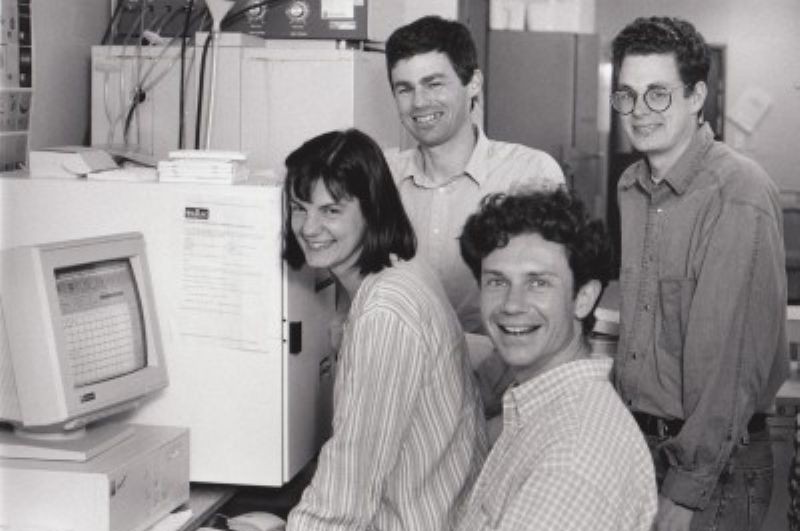
In the three decades Professor Graham Le Gros served as director of the Malaghan Institute, he brought together people to make a difference, uniting them under one goal: to bring life-changing, cutting-edge treatments to New Zealanders. Clockwise from left, Franca Ronchese, Graham Le Gros, John Holloway, and Rod Dunbar. Photo: Malaghan Institute of Medical Research.
Malaghan: Celebrating milestones in bringing life-saving cell therapies to New Zealand
As the Malaghan Institute of Medical Research marks a milestone with the delivery of their 50th CAR T-cell dose in November, they celebrate a significant anniversary that helped set it all in motion - enabling the manufacturing of cutting-edge cell therapies and laying the groundwork for pioneering clinical trials.
Twenty years ago, in 2005, the Malaghan Institute achieved its first GMP - Good Manufacturing Practice - licence, the green light from Medsafe that their laboratories had met the exacting standards required to prepare, process and culture human tissues for advanced cell therapies.
Professor Ian Hermans, whose research has been closely intertwined with the GMP facility, says attempting to incorporate a licenced manufacturing facility was, and still is, rare outside of commercial pharmaceutical companies.
“We made the decision to set one up because we were committed to running investigator-led studies of cellular immune therapies, something Professor Franca Ronchese initiated in the 1990s,” he says.
Expression of Interest: Co-Director, Medical Research Institute of New Zealand
The Medical Research Institute of New Zealand (MRINZ) invites expressions of interest from senior academic clinician researchers for a Co-Director role.
The appointment of a Co-Director is part of planned governance for leadership continuity at the MRINZ. Professor Richard Beasley, MRINZ's founding Director, is considering retirement in the medium to longer term.
Professor Beasley will continue in his current role until a suitable candidate is appointed to a Co-Director position.
Motu: 2025 Sir Frank Holmes Prize winner
Congratulations to Anushka Castaing, Motu's Sir Frank Holmes Prize winner this year.
Anushka is a third-year student at Victoria University of Wellington, studying a Bachelor of Science with a double major in Economics and Geography. Her studies have focused on econometrics and a quantitative approach to understanding social and environmental issues.
Every year Motu Research offers the Sir Frank Holmes Prize - a cash prize of $5,000 for the top economics undergraduate student in Aotearoa New Zealand.
The prize is offered to encourage top quantitative economics students to further their studies in econometrics at graduate level.
Cawthron Institute Trust Board announces new Chair
Lindsay McKenzie has been announced as the next Chair of the Cawthron Institute Trust Board.
He replaces John Palmer who has stepped down at the conclusion of two terms on the Board and Chair since 2019.
HERA: Weaving te ao Māori into everyday mahi
A question that we never tend to reflect on is: who is my mahi (work) really for? Whose values shape the way we work, communicate, and lead?
The team at HERA recently took part in Run Aotearoa's Te Ao Māori for Marketers workshop.
It wasn't about learning a checklist of cultural practices. It was a reminder to slow down and reflect on how we think, connect, and create, and what that means for the way we work in Aotearoa.
Te ao Māori (the Māori world view) teaches us that everything is connected. That purpose, balance, and respect for the natural world are foundations for survival and sustainability.
Bragato: Predicting the formation of calcium tartrate crystals in wine
A three-year research project sponsored by Bragato Research Institute (BRI) and carried out in partnership with the University of Canterbury is helping winemakers better manage calcium tartrate, an undesirable crystal that can appear in bottled wine.
Although harmless, the crystals are often mistaken for glass and can negatively affect consumer perception.
Researchers Jack Muir and Ken Morison developed a practical mathematical model to forecast the likelihood of calcium tartrate formation as low-, medium-, or high-risk, based on wine chemistry.
Malaghan: Dr Kerry Hilligan awarded Sir Charles Hercus Health Research Fellowship
The Malaghan Institute's Dr Kerry Hilligan has been awarded the Health Research Council's 2026 Sir Charles Hercus Health Research Fellowship.
The prestigious fellowship, valued at $600,000 over four years, supports researchers who demonstrate exceptional promise to open new frontiers in health research.
Malaghan: Making local impact using global training in liver cancer research
It has been a little under a year since Dr Olivia Burn returned to the Malaghan Institute from the Icahn School of Medicine at Mount Sinai Hospital in New York.
Liver cancer is a growing health challenge in New Zealand, with around 400 people diagnosed each year and limited treatment options.
Dr Burn has now established advanced liver cancer models at the Malaghan Institute, supporting research into liver cancer vaccines and immunotherapies.
Malaghan: A lasting legacy: advancing science, changing lives
In the three decades Professor Graham Le Gros served as director of the Malaghan Institute, he united people under one goal: bringing life-changing, cutting-edge treatments to New Zealanders.
In December 1994, the institute comprised fewer than 10 people and a collection of disparate research projects.
The arrival of Professor Graham Le Gros and Professor Franca Ronchese marked a turning point, laying the foundations for the institute's future impact.
Motu: 2024-2025 Annual Report is now available
The Motu Research 2024-25 Annual Report outlines Motu's achievements and financial performance over the year.
Despite a constrained science funding environment, Motu continued to win contracts and publish influential research.
The year included 13 working papers and Motu Notes addressing climate policy, labour markets, and child wellbeing.
Motu: Helping a new generation of researchers flourish
Building the capability of young researchers is a core objective for Motu Research.
Motu recently celebrated the achievements of former Research Analyst Sophie O'Brien and 2024 Āheitanga Thesis Scholarship winner Jake Koekemoer.
Motu: Overcoming challenges to make the energy transition a just labour transition
Motu researchers have contributed to a commentary published in the prestigious Nature Communications journal.
The article explores how the transition to a low-emissions economy can deliver decent work and protect livelihoods.
Catherine Leining, Dave Maré, Suzi Kerr and Euan Richardson are co-authors on the publication.
Tertiary scholars join Cawthron for a summer of science
Cawthron welcomed four tertiary-level students in late November to take part in its Summer Scholarships programme.
The scholarships provide 10 weeks of full-time research experience across a range of environmental science projects.
Nayland College students become marine biosecurity detectives
Cawthron has again partnered with Nayland College to deliver a hands-on marine biosecurity workshop for Year 9 students.
The workshop explored biodiversity, biosecurity, molecular tools and environmental DNA, woven together with Mātauranga Māori perspectives.
Opening the doors to Cawthron's Aquaculture Park
More than 200 people visited Cawthron's Aquaculture Park in Glenduan during the annual Open Day in early November.
The event showcased world-class aquaculture and marine science research supporting New Zealand's seafood sector.
Cawthron scientist awarded Royal Society fellowship
Cawthron Institute scientist Dr Rebecca McMullin has been awarded a New Zealand Mana Tūāpapa Future Leader Fellowship.
The fellowship will support the development of tools to detect environmental stress associated with offshore aquaculture.
Date posted: 17 December 2025