
IRANZ news briefs
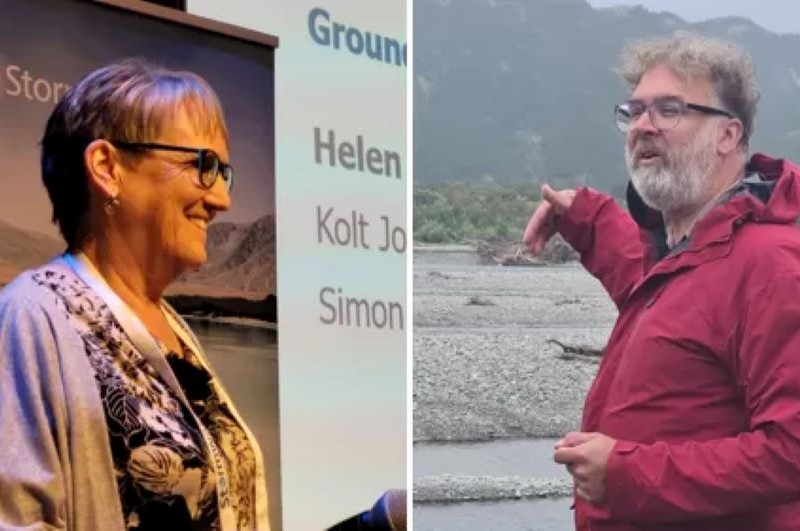
Two Lincoln Agritech scientists, Senior Research Scientist/ Senior Hydrogeologist Helen Rutter and Hydrogeologist Scott Wilson, have been selected to join an advisory panel supporting Taumata Arowai, New Zealand's Water Services Authority. Photo: Lincoln Agritech
ClimSystems' Dr Peter Urich outlines path to climate resilience through data and GIS
Dr Peter Urich, Managing Director of ClimSystems, shared strategic insights on transforming complex climate science into action on 22 May at the “ArcGIS and Climate Change” webinar.
Hosted by Eagle Technology, Esri's official ArcGIS software distributor in New Zealand and the South Pacific, the event highlighted the value of integrating expert climate data with advanced Geographic Information Systems (GIS). Dr Urich outlined ClimSystems' mission to break down big, complex data sets to make them accessible and usable through Geographic Information Systems (GIS). He stressed that visualising data on maps is key to effective communication and decision-making, a belief consistently validated throughout his career.
Mackie Research: Human Factors in the Land Transport System Short Course
Recently Mackie Research led and delivered the inaugural Human Factors in the Land Transport System short course. Hosted at Auckland Transport and sold out, the participants and team had a busy, thought provoking, energising, and successful day learning about how human factors and ergonomics can improve transport system outcomes. In particular, there was a real hunger for systems methods to better understand transport issues and potential solutions
Mackie Research was assisted by the Human Factors and Ergonomics Society of New Zealand, Auckland Transport, the AT Human Centred Design Team, Irene Tse, Clare George, Maggie Trotter, Amy Williamson, Dave Moore, and Rebecca Luther.
The team are now taking expressions of interest for a future courses - please contact them if you missed out.
Mātai Summer Internship Programme now open for applications
Applications for the Mātai Summer Internship Programme opened on Monday, 16 June and will close on Monday, 7 July 2025.
Undergraduate students (Years 1-4) studying science, health, engineering, or tech, are invited to apply, especially those with links to Tairāwhiti.
The Mātai Summer Internship Programme is a 10-week immersive experience, based in Gisborne, where students will:
- contribute to real-world research in brain imaging, concussion, child health, and more;
- learn alongside leading scientists, clinicians, and Māori health experts;
- gain skills in research methods, science communication, leadership, and mātauranga Māori; and
- be part of projects that connect back to the Tairāwhiti community.
Malaghan visiting researcher: Associate Professor Timothy Hand
What role does the infant gut microbiome play in shaping the developing immune system? A crucial one, says Associate Professor Timothy Hand, who recently shared his research investigating this relationship at the Malaghan Institute.
Magee-Womens Hospital in Pittsburgh, Pennsylvania, USA delivers more than 11,000 babies each year.
"That's about three births an hour, every hour, for 365 days a year," says the Associate Professor of Paediatrics and Immunology at the University of Pittsburgh.
Cawthron: Stories, not just statistics, will save environment
Cawthron Institute Freshwater Ecologist Dr Kati Doehring writes about the power of scientific story telling in this opinion article from the institute.
"Scientific data is essential for understanding the state of our environment, but numbers alone rarely move people to action. To truly connect with the public and spark meaningful change, we must bring data to life through storytelling.
"I have seen first-hand how a well-told story can shift conversations, open minds, and bridge the gap between complex science and public understanding. Data tells us what is happening, but stories help us understand why it matters. Take our rivers, for example. Water quality statistics can be confronting, yet impersonal. When I hear the story of a river that once supported thriving ecosystems and sustained whānau, now degraded by pollution or climate pressures, I do not just see a number, I feel the loss. That emotional connection is what turns information into a call to action.
"I am heartened to see the government embracing this approach in their environmental reporting over the last couple of years."
Cawthron: New Westpac report highlights huge potential of Aotearoa New Zealand's blue economy
In this opinion article by Dr Cath McLeod, Cawthron's Chief Science Officer, she reviews a report by Westpac. She writes that the recently published report highlights the potential of New Zealand's ocean estate to underpin the growth of a new, sustainable blue economy. "The report reveals that marine activity currently contributes at least $10bn in value add to the New Zealand economy, and predicts that by 2035, sector value add will rise to $14bn pa, with even higher growth possible if we are able to find sustainable ways of utilising marine mineral resources.
"I was pleased to see the report reiterate the necessity for a swing towards a blue economy, which in my view offers huge opportunity to fully integrate impeccable environmental credentials, social values, and high-tech marine innovation into the development of commercial products and services."
Lincoln Agritech: Annual Review 2024 highlights innovators
Lincoln Agritech is a company of next-generations innovators, and they celebrate them in their 2024 Annual Review.
It includes stories on the ground-breaking research of early career scientists, the new insights into water the Environmental Research team has uncovered, and their work to grow a new wool-based manufacturing export sector.
The report outlines work with clients and collaborators, helping them to extract higher value from natural materials, sustainably increase productivity, manage greenhouse gas emissions and more.
Malaghan: Brain and immunity
According to Professor Kjesten Wiig, Director of the Malaghan Institute, the future of brain research lies in neuroimmunology. As a trained neuroscientist, she explores how this fast-rising field could transform how we understand neurological disorders like Alzheimer's, Parkinson's and motor neuron disease.
"Few conditions inspire more dread than the creeping shadow of neurodegenerative disease. At times, it feels almost taboo to talk about, perhaps because it touches on something deeper than physical decline. We fear the loss of our mental faculty because it threatens the very core of who we are; our memories, our relationships, our sense of self. What makes neurodegenerative disease more unsettling is just how little we understand about these diseases and how few tools we have to stop them.
"So how can we protect our brains from decline and retain our health for longer? I believe the answer lies in our immune system.
"The brain is a unique organ, isolated from the rest of the body through the blood-brain barrier...”
Malaghan CAR T-cell cancer therapy trial expands to Christchurch and Auckland
The Malaghan Institute is one step closer to its goal of making CAR T-cell therapy a standard of care in New Zealand as its phase 2 clinical trial opens its doors in Christchurch and Auckland City Hospitals this month.
Clinical Director Dr Robert Weinkove says 'site activation' in Christchurch and Auckland marks a significant milestone for the clinical trial, and means more patients can be treated, closer to home.
“This is an exciting step for this national endeavour, as we prepare the New Zealand health system to deliver this game-changing cancer treatment. As a one-off, outpatient-based treatment, CAR T-cell therapies could help to meet an urgent unmet need while limiting pressure and costs on the health system.”
Motu Research: Cost-benefit behind $10b Northland highway called into question
Motu Research Affiliate Dr Simon Chapple did an independent analysis for Parliament's transport and infrastructure committee of an NZ Institute of Economic Research report - and questions the report's conclusions about benefits of the proposed Northland expressway.
The NZIER report makes the case for the Northland expressway to be built - which could consume 10% of the Government's entire infrastructure budget in coming decades.
Simon found the economic benefits of the expressway were overstated and can't be easily verified.
Cawthron & iwi partners secure support for seaweed research
Cawthron Institute and iwi/hapū research partners are celebrating the success of two mātauranga Māori focused research projects that have secured funding through the 2025 Vision Mātauranga Capability Fund (VMCF), administered by the Ministry of Business, Innovation and Employment (MBIE).
The first project, in partnership with Te Rūnanga o Kaikōura, focuses on karengo (a type of edible red seaweed closely related to Japanese nori) found along the Kaikōura coastline. Revered by Māori for generations as a nutritious delicacy and environmental indicator, karengo is now the subject of an innovative research initiative blending mātauranga Māori and ecological science.
The second collaborative project with the Whangārei Harbour Kaitiaki Roopū will enhance collective understanding about increasing rimurimu (seaweed) strandings along the Whangārei coast, which are affecting coastal ecosystems and hapū wellbeing. It will also investigate opportunities arising from these events.
Lincoln Agritech: Scientists selected for expert panel
Two Lincoln Agritech scientists, Senior Research Scientist/ Senior Hydrogeologist Helen Rutter and Hydrogeologist Scott Wilson, have been selected to join an advisory panel supporting Taumata Arowai, New Zealand's Water Services Authority.
The panel will play a crucial role in strengthening the regulator's scientific and technical foundation. Members will provide technical input into drinking water regulation, supporting the authority's vision of safe water every day for everyone. They will also be called upon to offer technical input during water-related incidents or emergencies.
Lincoln Agritech: Researchers & iwi gather for project
Waikato-Tainui and Ngāti Korokī Kahukura formally welcomed and acknowledged the Emerging Climatic Pressures research group last month with a mihi whakatau at Mystery Creek.
Much of the research programme, which is investigating the effects of rising atmospheric CO2 levels on freshwater systems, particularly the Waikato River, takes place in their rohe.
“We are really interested in any and all interactions with our awa, which we see as our tupuna, our ancestor,” says Merekara Warrington, a Ngāti Korokī Kahukura trustee.
“We want to make sure that the awa is being respected, and that the research brings benefit back to the river. We are really there as kaitiaki, or guardians.”
Roland Stenger, principal scientist of Lincoln Agritech's Environmental Research team, provided a brief overview of the programme. He highlighted that changes in water and sediment chemistry will affect the plants and animals living in the river, which are critically important to mana whenua.
Date posted: 26 June 2025