
IRANZ news briefs
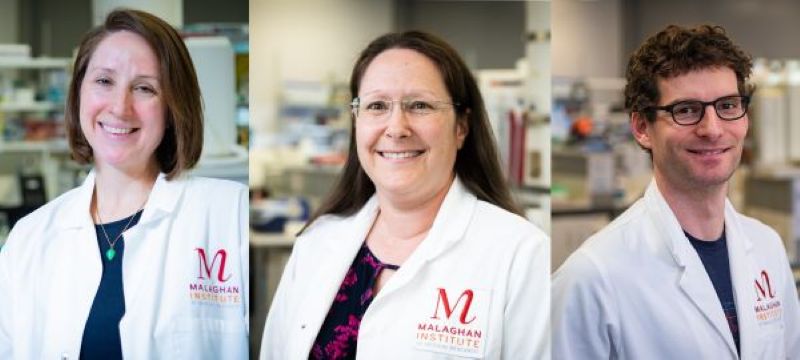
Researchers at the Malaghan Institute, led by Dr Michelle Linterman, have been awarded a Catalyst Seeding grant from Royal Society Te Apārangi to investigate how metabolism shapes the way immune cells work. The project brings together international and multidisciplinary expertise, linking scientists at the Malaghan Institute with Dr Theodore Alexandrov's team at the University of California, San Diego. Together, they aim to uncover how metabolic processes influence immune responses, paving the way for better vaccines and cancer treatments. From left: Dr Michelle Linterman, Dr Rachel Perret, Dr David O'Sullivan. Photo montage: Malaghan Institute of Medical Research.
WSP: Ageing population focus of Parliament breakfast event
A new WSP and Helen Clark Foundation report on the infrastructure implications of Aotearoa New Zealand's ageing population was the subject of spirited discussion at a breakfast event at Parliament on Monday 20 October.
Report author, WSP Fellow Kali Mercier was joined on a panel by Minister of Infrastructure Hon Chris Bishop and Labour Spokesperson for Housing, Infrastructure and Public Investment Kieran McAnulty.
After opening remarks by WSP managing director Ian Blair, Kali outlined the scale of the demographic challenge the country is facing across housing, aged care, and health infrastructure. Currently, fewer than one in five New Zealanders are over 65. In 2078, that number is projected to be one in three.
Infrastructure is set to feel the strain. In healthcare, for example, sixty-three percent of all public health services will be used by people aged over 65 by 2051. By 2040, only half of people aged 65+ will own their own homes - down from eighty-two percent in 2001. Elsewhere, there could be a shortage of almost twelve-thousand aged care beds by 2032.
Aqualinc: Experts selected for Taumata Arowai panel
Three of Aqualinc's expert engineers and scientists have been selected to join an advisory panel supporting Taumata Arowai, New Zealand's Water Services Authority: Julian Weir, Principal Engineer - Groundwater Modelling Lead Consultant, Andrew Dark, Technical Director, and Ross Hector, Principal Hydrogeologist.
The panel will be instrumental in reinforcing the regulator's scientific and technical foundation, bringing critical expertise to the forefront of drinking water regulation, and advancing the authority's commitment to safeguarding water quality for all, every day.
Motu: Stuart Donovan appointed to Infrastructure Priorities Programme independent review panel
Motu's Senior Fellow Stuart Donovan was recently reappointed to the independent review panel for the New Zealand Infrastructure Commission, Te Waihanga's Infrastructure Priorities Programme (IPP).
Aotearoa New Zealand faces many infrastructure challenges - and we can't afford to build everything at once. The IPP helps the country identify the top infrastructure issues and solutions, so decision-makers can focus resources where they'll have the greatest impact.
The Infrastructure Priorities Programme creates a public menu of priority proposals, each going through a standardised, independent review by the Commission.
The panel, including Stuart, reviews the Commission's assessments and makes recommendations before they're released, ensuring the process is independent, robust, and follows best practice.
2025 Mātai Public Symposium: Back to the Image of the Future
28-29 November 2025
War Memorial Theatre, Gisborne
Join Mātai Medical Research for two inspiring days of conversations and discovery at the Mātai Public Symposium 2025 - exploring the latest advances in imaging, health, science, technology, and innovation.
This free public event brings together scientists, educators, innovators, and community leaders to discuss how imaging, technology, and collaboration are transforming the future of health and wellbeing across Aotearoa and beyond.
Malaghan: New funding supports cutting-edge research into immune cell metabolism
Researchers at the Malaghan Institute, led by Dr Michelle Linterman, have been awarded a Catalyst Seeding grant from Royal Society Te Apārangi to investigate how metabolism shapes the way immune cells work. The project brings together international and multidisciplinary expertise, linking scientists at the Malaghan Institute with Dr Theodore Alexandrov's team at the University of California, San Diego. Together, they aim to uncover how metabolic processes influence immune responses, paving the way for better vaccines and cancer treatments.
MRINZ: Te Wiki o Te Reo Māori 2025
To celebrate Te Wiki o Te Reo Māori 2025, the Medical Research Institute of New Zealand (MRINZ) has a number of profiles from their researchers:
- Wiki o Te Reo Māori 2025 — Trisha Falleni's Journey of Discovery
- Te Wiki o Te Reo Māori 2025 — Jackson Smeed-Tauroa on Honouring the Past and Shaping Tomorrow
- Te Wiki o Te Reo Māori 2025 — Bianca Crichton is Weaving Whakapapa, Weaving Futures
Student collaboration celebrated at Cawthron Scitec Expo 2025 prizegiving
This October, budding scientists were celebrated at the 2025 Scitec Expo Awards ceremony, recognising the creativity, curiosity and collaboration of young people across Te Tauihu.
This year's Expo showcased an exceptionally high calibre of entries, reflecting the excellent scientific and artistic talent in our region. The event encourages students to think and behave like scientists by exploring topics that matter to them through hands-on, creative investigation.
HERA: The critical role of protective coatings and inspection in steel structures
Steel remains the backbone of modern infrastructure, from bridges and high-rise buildings to pipelines, tanks, and vessels designed for marine environments. Steel's durability and versatility make it essential, but steel's natural vulnerability to corrosion poses a serious challenge. Protective coatings serve as the first line of defence against environmental corrosion, ensuring that steel structures achieve their designed service life safely and cost-effectively.
Corrosion is a costly and constant threat and the World Corrosion Organisation (WCO), estimates global corrosion costs in the trillions of US dollars annually, with a significant portion of this share absorbed by infrastructure owners. This high cost highlights the critical need for effective corrosion prevention and mitigation to safeguard infrastructure and reduce risk to assets.
BRANZ: Seismic resilience when retrofitting homes
Licensed building practitioners (LBPs) and other building professionals now have access to two new seismic resilience modules designed to help strengthen New Zealand homes against earthquakes.
The modules provide practical guidance for builders when retrofitting homes in Aotearoa to meet seismic safety standards, and have been developed by MBIE, BRANZ, and the Natural Hazards Commission Toka Tū Ake, and the building industry.
Malaghan: The making of NZ's first CAR T-cell trial
Dr Brigitta Mester, the Malaghan Institute's R&D and process development manager, has been at the heart of bringing New Zealand's first CAR T-cell clinical trials to life, doing the groundwork to ensure the therapy meets world-class standards and safety.
Brigitta's office for many years was nestled at the end of the first-floor corridor opposite the most tightly controlled labs at the institute. These labs contain machines that look like they've come straight out of a sci-fi novel.
Safeguarded by layers of automation and quality control, each Cocoon is designed to reprogramme a patient's own immune cells into a cancer therapy just for them. For these patients, many of whom have exhausted every other treatment for their blood cancer, the cells are a last chance.
The Malaghan's ENABLE CAR T-cell clinical trial programme, now in phase 2, represents the culmination of monumental effort by many. Brigitta has been pivotal at every step of the Malaghan Institute's journey to bring this cancer therapy to New Zealanders.
“When the Malaghan Institute first set out to run New Zealand's inaugural CAR T-cell clinical trial, the facilities looked very different,” says Brigitta.
Malaghan: Cancer, measles, & allergic disease research funded
The Malaghan Institute has been awarded three Health Research Council grants, totalling $7.4M over five years, to improve cancer immunotherapies, protect vulnerable populations from measles outbreaks and investigate new therapeutic targets for eczema, advancing research that addresses some of the most pressing health challenges facing Aotearoa New Zealand today.
Director Professor Kjesten Wiig says receiving three major grants from the Health Research Council at a time of heightened funding constraints is significant and recognises the calibre and relevance of the Malaghan Institute's science.
"These investments not only reflect confidence in the Malaghan's research across cancer, allergic and infectious diseases, but also the real-world impact of our work on the health of New Zealanders."
Projects include re-engineering CAR T-cells to overcome exhaustion and enhance cancer therapy, developing an mRNA-based measles vaccine for vulnerable groups, and exploring novel therapeutic pathways for atopic dermatitis.
Malaghan CAR T programme wins KiwiNet Research Commercialisation Award
The Malaghan Institute’s CAR T-cell programme has won the PwC Breakthrough Project Award at the KiwiNet Research Commercialisation Awards 2025, recognising a breakout project that has recently launched to success and demonstrates best-practice commercialisation of publicly-funded research.
Aqualinc: Will your irrigation consent be renewed?
In the September issue of Canterbury Farming Newspaper, Aqualinc's Matt Bubb asks an important question for irrigators: will your irrigation consent be renewed? Resource consents are only valid for a set time, and before they expire, a replacement application is required.
While most consent holders who are actively using their consents should be able to renew them, the process is not automatic. Renewal applications are treated much like new ones, with councils applying current rules and requirements that may differ from when the original consent was granted. This can lead to new conditions, such as stricter controls where bores affect surface water, or requirements to upgrade fish screens to modern standards.
Applicants must also prove the water is needed. Robust water meter data is vital, and in future, soil moisture records may be required to demonstrate efficient use. Ironically, careful users can be penalised under the current "use it or lose it" approach.
Consent durations may also be shorter and aligned with other farm consents. Matt advises farmers to seek expert advice early – ideally 18–24 months before expiry – and to maintain accurate records to support renewal applications.
Cawthron Institute Trust Board seeking new Trustee
The Cawthron Institute Trust Board (Trust Board) was established by an Act of Parliament to carry out instructions in the Will of Mr Thomas Cawthron. It comprises five statutory Trustees (Nelson Member of Parliament, Nelson City Council Mayor, Tasman District Council Mayor, the Nelson Bishop, and a trustee appointed as the Te Tauihu Iwi Member) and six other Trustees to represent Te Tauihu. The Trust Board is charged under the Thomas Cawthron Amendment Act 2023 with the governance of Cawthron Institute.
Cawthron are seeking an applicant from Nelson, Tasman, Golden Bay, Marlborough, or Kaikōura to fill a Trustee vacancy. The Trust Board meets four times per year; the level of involvement outside this is optional and varies with projects.
Date posted: 30 October 2025